| 1. | DNA molecules isolated from a rat cell and a human cell are found to differ in the | |
 |
A. | order of their bases |
|
B. | the type of bases they contain |
|
C. | the type of sugar the DNA is made with |
|
D. | the order of the phosphate groups |
| 2. | If a DNA molecule contains 10,000 bases, of which 18% are thymine (T), then the number of cytosine (C) molecules present would be | |
|
A. | 1800 |
|
B. | 3200 |
|
C. | 6400 |
|
D. | 8200 |
| 3. | If a DNA molecule contains 4000 bases and 1200 of these are adenine (A), then the percentage of the bases which woudlbe guanine (G) would be | |
|
A. | 12 |
|
B. | 20 |
|
C. | 28 |
|
D. | 30 |
| 4. | An mRNA template is | |
|
A. | copied from protein |
|
B. | translated by protein |
| |
C. | copied from DNA |
|
D. | translated by DNA |
| 5. | What molecule controls the order in which amino acids are added to a growing protein? | |
|
A. | DNA molecules |
|
B. | mRNA molecules |
|
C. | amino acids |
|
D. | ribosomes |
|
E. | mitochondria |
| 6. | A fragment of DNA was found to have 120 guanine bases and 60 adenine bases. What is the total number of sugar molecules in this fragment? | |
|
A. | 60 |
|
B. | 90 |
|
C. | 180 |
|
D. | 360 |
| 7. | The model of DNA used today was proposed by James Watson and Francis Crick in 1953. In this model, what sequence of bases would be complementary to A-G-C-T-A? | |
|
A. | A-G-C-T-A |
|
B. | C-G-C-A-T |
|
C. | A-T-C-G-A |
|
D. | T-C-G-A-T |
| 8. | The diagram below shows part of a DNA molecule during replication. Identify part X
|
||||||||||||
|
A. | base | |
B. | phosphate | |
C. | sugar | |
D. | nucleotide | ||
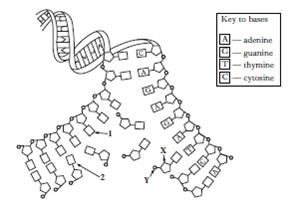
| 9. | The diagram below shows part of a DNA molecule during replication. Name base 1
|
||||||||||||
|
A. | A (adenine) | |
B. | T (thymine) | |
C. | G (guanine) | |
D. | C (cytosine) | ||
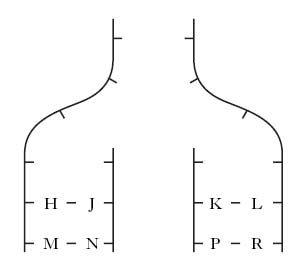
| 10. | The diagram shows DNA during replication. Base H represents thymine and base M represents guanine. Which letters represent the base cytosine?
|
||||||||||||
|
A. | J and K | |
B. | J and L | |
C. | N and P | |
D. | N and R | ||
| 11. | A section of a DNA molecule contains 300 bases. Of these bases, 90 are adenine. How many cytosine bases would this section of DNA contain? | |
|
A. | 60 |
|
B. | 90 |
|
C. | 120 |
|
D. | 180 |
| 12. | Tissue samples taken from the heart and stomach of a grasshopper would be expected to have the same — | |
|
A. | cell shape |
|
B. | cell size |
|
C. | mRNA |
|
D. | DNA |
| 13. | Amino acids link together by peptide bonds to form proteins. In which part of the cell would this process occur | |
|
A. | Mitochondrion |
|
B. | Ribosome |
|
C. | Nucleus |
| D. | Chloroplast | |
| 14. | Which of these is most responsible for carrying coded information from the nucleus? | |
|
A. | The cell membrane |
|
B. | The ribosomes |
|
C. | mRNA |
|
D. | DNA |
| 15. | Proteins are formed from monomers (subunits) called — | |
|
A. | amino acids |
|
B. | phospholipids |
|
C. | sugars |
|
D. | nucelotides |
| 16. | A cell with numerous ribosomes is probably specialized for — | |
|
A. | enzyme storage |
|
B. | energy production |
|
C. | cell division |
|
D. | protein synthesis |
| 17. | The parts of DNA that provide the code for proteins are the — | |
|
A. | sugars |
|
B. | phosphates |
|
C. | weak bonds |
|
D. | bases |
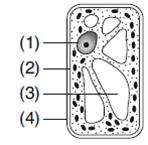
| 18. | Which cell structure contains information needed for protein synthesis?
|
||||||||||||
|
A. | 1 | |
B. | 2 | |
C. | 3 | |
D. | 4 | ||
| 19. | Which sequence best represents the relationship between DNA and the characteristics or traits of an organism?
|
||||||||||||
|
|
|
|
||||||||||
| A. | 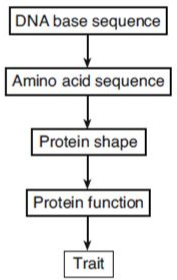 |
B. | 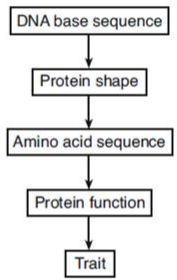 |
C. | 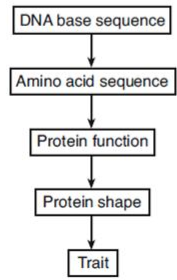 |
D. | 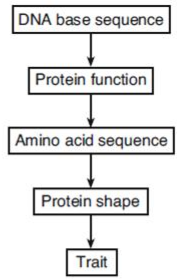 |
||||||
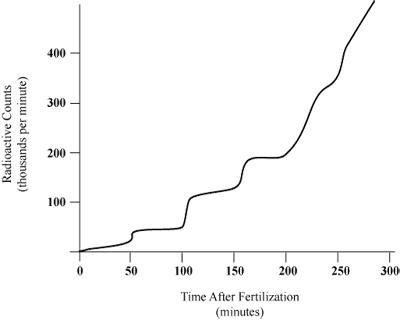
| 20. | Thymine is used by animal cells primarily for the synthesis of DNA. A group of sea urchin eggs was fertilized in sea water containing radioactive thymine. Following fertilisation, samples of embryos were removed at regular intervals and the radioactivity in the nucleic acid was measured in counts per minute. The results obtained are shown in the figure below.
An appropriate control to show that this experiment measures DNA synthesis and not RNA synthesis would be to perform the same procedures but |
||||||
|
A. | not fertilise the eggs | |
B. | sample the embryos at longer time intervals | ||
|
C. | add radioactive uracil instead of radioactive thymine | |
D. | fertilize the eggs in sea water that does not contain radioactive thymine | ||
| 21. | Proteins have different functions. Which of the following statements identifies a protein and its function? | |
|
A. | Hormones carry oxygen around the body. |
|
B. | Enzymes carry chemical messages around the body. |
|
C. |
Antibodies defend the body against disease.
|
|
D. |
Cellulose provides strength and structure to a plant cell wall.
|