| 1. | Which of the following stages in respiration would result in the production of no molecules of ATP? | |
 |
A. | Glucose to pyruvic acid |
|
B. | Pyruvic acid to lactic acid |
|
C. | Pyruvic acid to carbon dioxide and water |
|
D. | Glucose to carbon dioxide and water |
| 2. | Which of the following stages in respiration would result in the production of 2 molecules of ATP? | |
|
A. | Glucose to pyruvic acid |
|
B. | Pyruvic acid to lactic acid |
|
C. | Pyruvic acid to carbon dioxide and water |
|
D. | Glucose to carbon dioxide and water |
| 3. | Which change represents the way in which ATP is produced during anaerobic respiration in cells? | |
|
A. | ADP + energy → ATP + Pi |
|
B. | ADP + Pi + energy → ATP |
|
C. | ADP + Pi → ATP |
|
D. | ADP + Pi → ATP + energy |
| 4. | Which change represents the way in which ATP is broken down in cells? | |
|
A. | ATP → ADP + Pi + energy |
|
B. | ATP + energy → ADP + Pi |
|
C. | ATP + Pi → ADP + energy |
|
D. | ATP → ADP + Pi |
| 5. | The energy for the formation of ATP during anerobic respiration in cells comes from | |
|
A. | ADP |
|
B. | glucose |
|
C. | inroganic phosphate |
|
D. | enzymes |
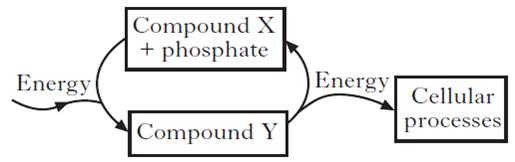
| 6. | The diagram below shows energy transfer within a cell. Compound Y would be
|
||
|
A. | ATP | |
|
B. | Glucose | |
|
C. | carbon dioxide | |
|
D. | ADP | |
| 7. | The energy yield per glucose molecule during anaerobic respiration is | |
|
A. | 2 molecules of ATP |
|
B. | 18 molecules of ATP |
|
C. | 36 molecules of ATP |
|
D. | 38 molecules of ATP |
| 8. | The anaerobic breakdown of glucose splits from the aerobic pathway of respiration | |
|
A. | after the formation of pyruvic acid |
|
B. | at the start of the breakdown of glucose |
|
C. | after carbon dioixde and water has been produced |
|
D. | after the formation of lactic acid |
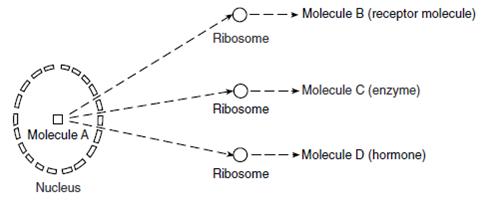
| 9. | Examine the diagram below, which represents a sequence of events in a biological process that occurs within human cells. Molecules B, C, and D are similar in that they are usually
|
||
|
A. | composed of genetic information | |
|
B. | involved in the synthesis of antibiotics | |
|
C. | composed of amino acids | |
|
D. | involved in the diffusion of oxygen into the cell | |
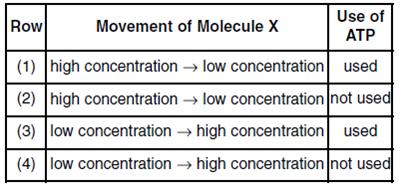
| 10. | Molecule X moves across a cell membrane by diffusion. Which row in the chart below best indicates the relationship between the relative concentrations of molecule X and the use of ATP in Active Transport?
|
||
|
A. | 1 | |
|
B. | 2 | |
|
C. | 3 | |
|
D. | 4 | |
| 11. | Which row in the chart below contains correct information concerning synthesis?
|
||
|
A. | 1 | |
|
B. | 2 | |
|
C. | 3 | |
|
D. | 4 | |

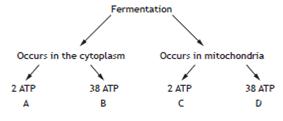
| 12. | Which of the following shows the correct location and number of ATP molecules released from a molecule of glucose during fermentation?
|
||
|
A. | A | |
|
B. | B | |
|
C. | C | |
|
D. | D | |