
| 2. | If the ribosomes of a cell were destroyed, what effect would this most likely have on the cell? | |
 |
A. | It would stimulate mitotis |
|
B. | The cell would be unable to synthesize |
|
C. | The cell would devlop abnormally |
|
D. | Increased protein absorption would occur through the cell membrane |
| 3. |
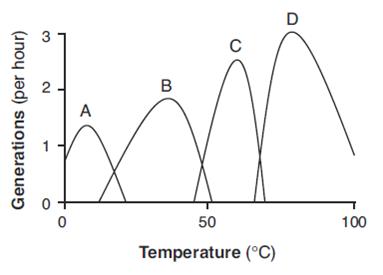
The graph below provides information about the reproductive rates of four species of bacteria, A, B, C, and D, at different temperatures.
Which statement is a valid conclusion based on the information in the graph?
|
||
|
A. | Changes in temperature cause bacteria to adapt to form new species. | |
|
B. | Increasing temperatures speed up bacterial reproduction. | |
|
C. | Bacteria can survive only at temperatures between 0°C and 100°C. | |
|
D. | Individual species reproduce within a specific range of temperatures. | |
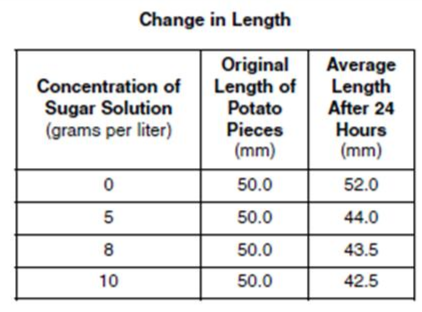
| 4. | Students cut 20 rod-shaped pieces of potato of the same diameter and length. Five pieces of potato were placed into each of four beakers containing different concentrations of sugar solutions. Each potato piece was measured again after 24 hours. The table below shows the results of their experiment.
Which graph best represents the information in the data table?
|
||||||
|
A. | 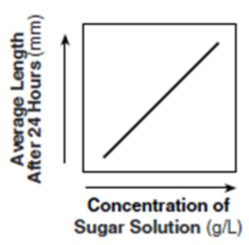 |
|
B. | 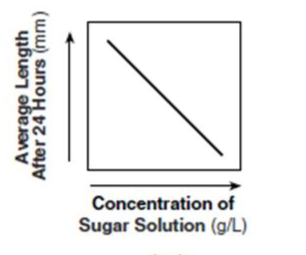 |
||
|
C. | 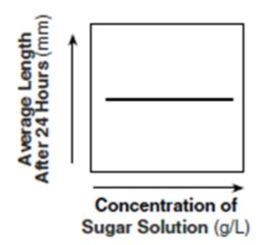 |
|
D. | 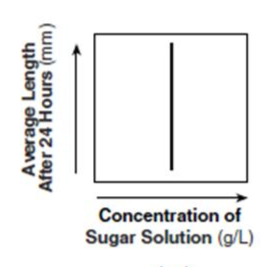 |
||
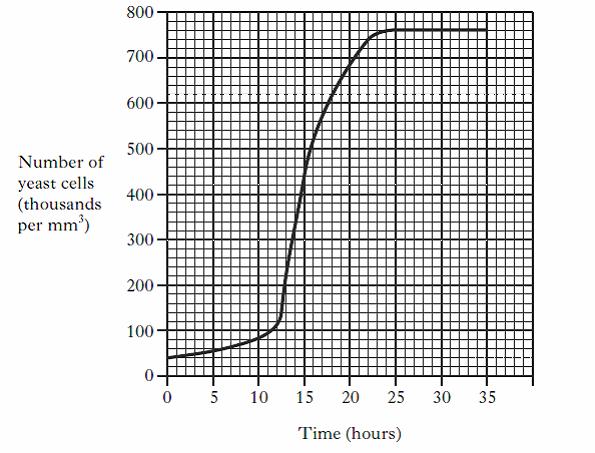
| 5. | Yeast cells were grown and their numbers recorded over a 35 hour period. The results are shown on the graph. How many times greater was the maximum number of yeast cells compared to the number at the start?
|
||||||||||||
|
A. | 1.02 | |
B. | 18 | |
C. | 19 | |
D. | 720 | ||
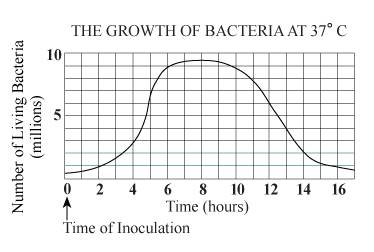
| 6. | In the graph below, the time when the number of living bacteria is increasing at the greatest rate occurs
|
|||||||||
|
A. | during the first 2 hours | |
B. | between the 2nd and the 4th hour | |
C. | between the 4th and the 6th hour | ||
|
D. | between the 6th and the 10th hour | |
E. | between the 11th and the 13th hour | |||||
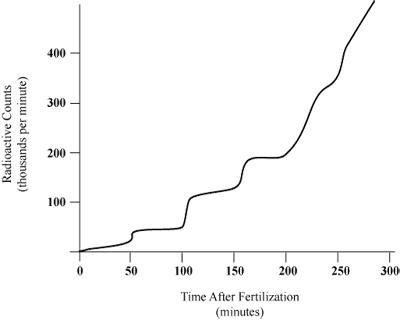
| 7. | Thymine is used by animal cells primarily for the synthesis of DNA. A group of sea urchin eggs was fertilized in sea water containing radioactive thymine. Following fertilisation, samples of embryos were removed at regular intervals and the radioactivity in the nucleic acid was measured in counts per minute. The results obtained are shown in the figure below.The increase in radioactivity of the embryos with time probably results from
|
||||||
|
A. | synthesis of new proteins by the developing embryos | |
B. | synthesis of radioactive thymine by the developing embryos | ||
|
C. | oxidation of radioactive thymine | |
D. | incorporation of radioactive thymine in new cell membranes | ||
|
E. | incorporation of radioactive thymine in new DNA during replication | |||||
| 9. | Which of the following cell structures would contain DNA? | |
|
A. | cytoplasm |
|
B. | ribosome |
|
C. | cell membrane |
|
D. | nucleus |
| 10. | Which of the following is not an accurate description of a chromosome? | |
|
A. | It is a coloured body localised in the nucleus |
|
B. | It is the cellular structure that contains the genetic material. |
|
C. | It is composed of many DNA molecules attached end to end |
|
D. | It is where genes are found |
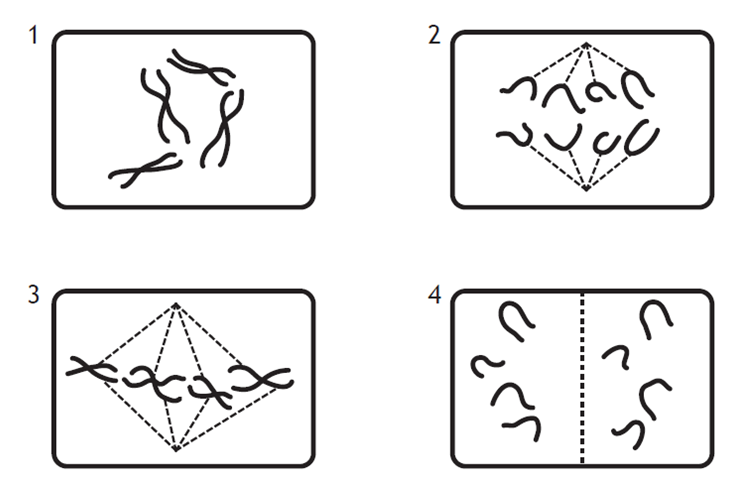
| 11. | The following diagrams show a cell at four different stages of mitosis.
The correct order of the stages of mitosis is |
|
|
A. | 1,3,2,4 |
|
B. | 2,3,4,1 |
|
C. | 3,2,1,4 |
|
D. |
4,1,2,3
|
| 12. |
A cell has mitochondria, ribosomes, a nucleus, and other parts.
Based on this information, it could not be
|
|
|
A. | a cell from a pine tree. |
|
B. | a grasshopper cell. |
|
C. | a yeast (fungus) cell. |
|
D. | a bacterium. |
|
E. | it could be any of the above. |
| 13. | The diagram below shows one of the stages of mitosis in the root tip of a plant. Which of the following statements describes the stage shown?
|
||||||
|
A. | Chromosomes line up at the equator of the cell | |
B. | Daughter chromosomes gather at the ends of the cell | ||
|
C. | Chromosomes become visible as pairs of identical chromatids | |
D. | Spindle fibres pull chromatids to opposite poles of the cell | ||