
The Marking Guide has been made available. Use this where you are having difficulty to help you understand the question better. Simply copying the answers from the Marking Guide will not help you learn, using it to help you understand the questions/ answers will.
You will need your Glow login to access the Marking Guide.
1. The experiment shown below was set up to demonstrate aerobic respiration in peas that are germinating (starting to grow).
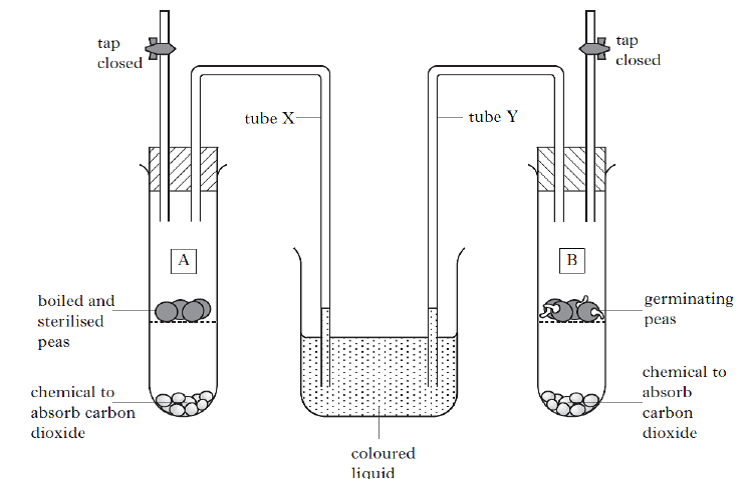 After two days, the level of liquid had risen in tube Y but had not risen in tube X.
After two days, the level of liquid had risen in tube Y but had not risen in tube X.
a) Explain the purpose of A as a control in this experiment.
b) Predict the effect on the level of the liquid in tube Y if a greater mass of peas is used.
c) What happens to the volume of gas in test tube B?Explain why this change occurs.
d) Explain why the liquid in tube Y rises in this experiment.
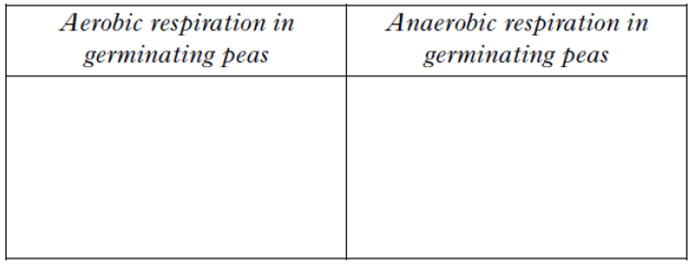
e) The following list contains some features of aerobic and anaerobic respiration in germinating peas.
List
W Does not use oxygen
X Produces carbon dioxide
Y Yields 38 molecules of ATP per glucose molecule
Z Produces ethanol
Copy and complete the table below by writing the letters from the list in the correct columns.
Each letter may be used once or more than once.
 2.The diagram shows an industrial fermenter. It is fitted with a number of taps which allow substances to be added or removed.
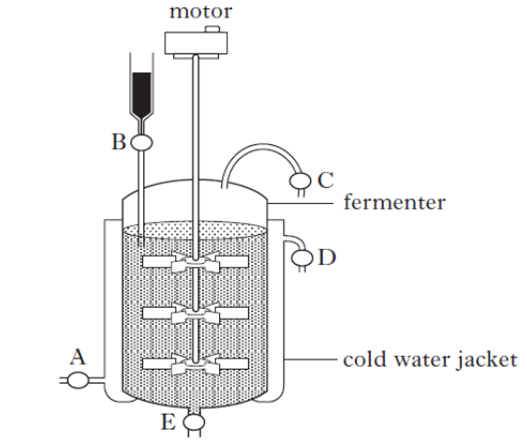
Barley malt extract, water and yeast were placed in the fermenter and left for several days.
The rate of fermentation was measured and the results are shown in the graph below.
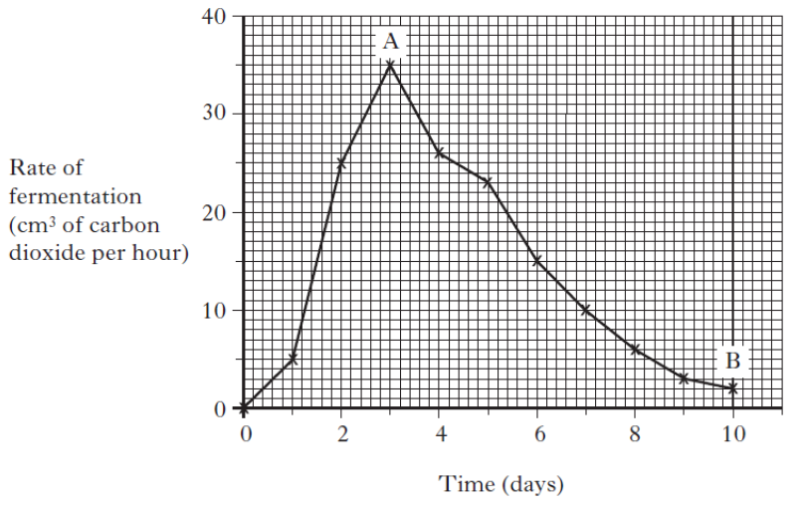 a) Describe the changes in the rate of fermentation over the ten days.
b) Suggest a reason for the change in the rate of fermentation between points A and B.
c) A temperature probe in the fermenter malfunctioned and the temperature exceeded 70°C.The yeast died and fermentation stopped.Explain why fermentation stopped.
d) Which of the taps, A, B, C, D or E, would open to
i) add nutrients to the mixture?
ii) remove waste gases?
iii) drain off the products?
e) The fermenter should be kept at 35 °C. Explain why the water jacket around the fermenter needs to be cold.