Marking Guide
| 1. |
A plant cell, which was placed in a liquid, lost water by osmosis. When compared to the liquid, the cell contents are described as being |
 |
A. |
plasmolysed |
|
B. |
hypertonic |
|
C. |
hypotonic |
|
D. |
flaccid |
| |
| 3. |
When animal cells are placed in a hypertonic solution they |
|
A. |
shrink |
|
B. |
burst |
|
C. |
become turgid |
|
D. |
become plasmolysed |
| |
| 4. |
Which structural feature is common to both plant and animal cells? |
|
A. |
Cell wall |
|
B. |
Chloroplast |
|
C. |
Cell membrane |
|
D. |
Large central vacuole |
| |
| 5. |
What does a plant cell contain that an animal cell does not? |
|
A. |
cytoplasm |
|
B. |
nucelus |
|
C. |
large vacuole |
|
D. |
cell membrane |
| |
| 6. |
Both animal and plant cells usually have a |
|
A. |
nucleus, cell membrane and cytoplasm |
|
B. |
nucleus, cell wall and chloroplasts |
|
C. |
nucleus, vacuole and cell wall |
|
D. |
nucleus, cell wall and cytoplasm |
| |
| 7. |
An important feature of the nucleus is that it |
|
A. |
is full of water |
|
B. |
has a round shape |
|
C. |
contains information |
|
D. |
makes a thin barrier |
| |
| 8. |
Red blood cells burst when they are placed in water because |
|
A. |
the cell contents are hypotonic to the water |
|
B. |
the cell contents are isotonic to the water |
|
C. |
the water is hypotonic to the cell contents |
|
D. |
the water is hypertonic to the cell contents |
| |
| 9. |
Which term best describes how water enters and leaves cells? |
|
A. |
diffusion |
|
B. |
osmosis |
|
C. |
evaporation |
|
D. |
permeation |
| |
| 10. |
Which statement best describes a selectively permeable membrane? |
|
A. |
it lets all substances through |
|
B. |
it does not let substances through |
|
C. |
it is equally permeable to all substances |
|
D. |
it lets some substances through but not others |
| |
| 11. |
A 5% sugar solution contains |
|
A. |
5% water and 95% sugar |
|
B. |
5% sugar and 95% water |
|
C. |
95% water and 95% sugar |
|
D. |
5% water and 5% sugar |
Three plant cells P, Q and R are found on a microscope slide.
Cell P is hypotonic to cell Q.
Cell R is hypertonic to cell Q.
| |
| 13. |
Which of the following best explains why red blood cells burst when they are placed in water? |
|
A. |
water enters the cell by osmosis, from a low water concentration to a higher water concentration inside the cell |
|
B. |
water leaves the cell by osmosis, from a high water concentration to a lower water concentration outside the cell |
|
C. |
water enters the cell by osmosis, from a high water concentration to a lower water concentration inside the cell |
|
D. |
water leaves the cell by osmosis, from a high water concentration to a lower water concentration outside the cell |
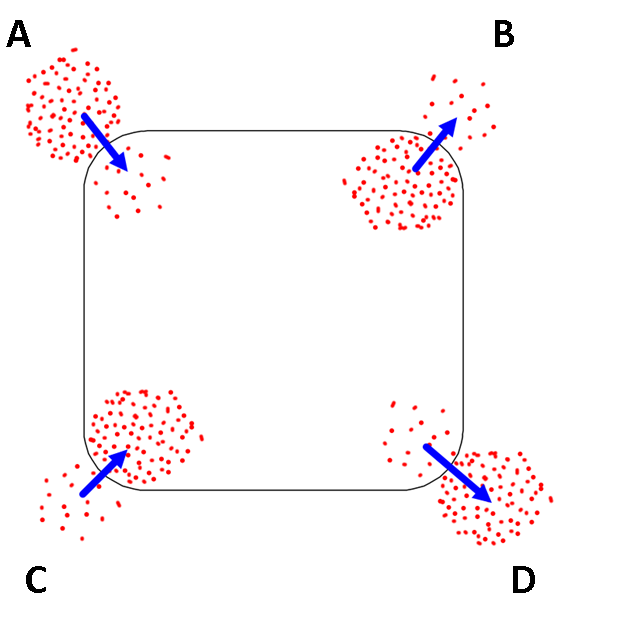
Choose letter A, B, C or D from the following diagram to answer questions 15 and 16 below.
The diagram shows the ways in which molecules may move into or out of an animal cell.
| |
| 18. |
The cell membrane contains |
|
A. |
cellulose and protein |
|
B. |
phospholipids and cellulose |
|
C. |
phospholipids and proteins |
|
D. |
proteins, phospholipids and cellulose |
| |
| 19. |
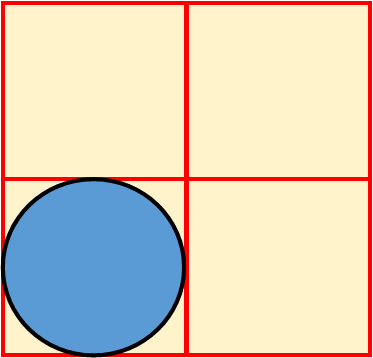
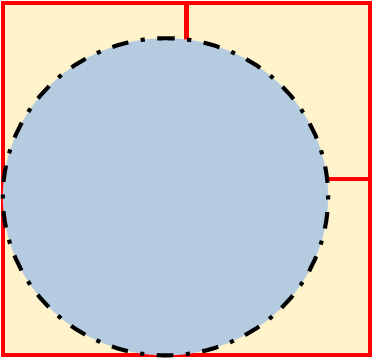
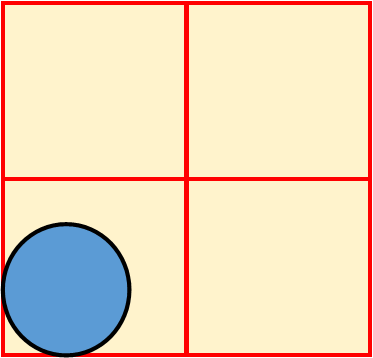
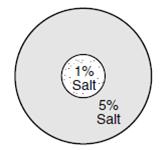
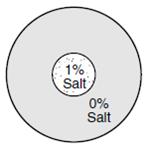
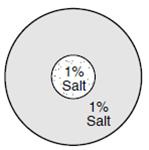
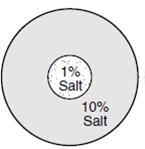
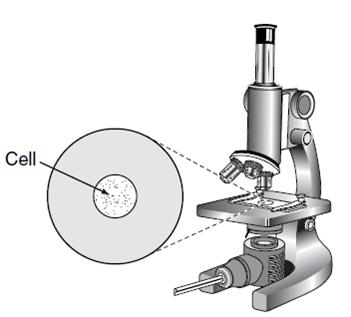 A student was studying the responses of cells to solutions of varying salt concentrations. A student was studying the responses of cells to solutions of varying salt concentrations.
Which solution below would cause no change in cell size? |
|
A. |
 |
|
B. |
 |
|
C. |
 |
|
D. |
 |