ATTENDANCE at Springfield Primary School
It’s important that your child attends school. It’s essential for their well-being as well as for their learning.
Attendance at school for young people is stipulated in national legislation and in international treaties (United Nations Convention on the Rights of the Child Article 28).
Every child has the right to grow up fully included in their learning experience and to be treated with respect (Included, Engaged and Involved Part 1: Promoting and Managing School Attendance).
You play an important role in ensuring your child attends regularly. Our staff and support services will work with you to help them attend school consistently and on time. Our policy allows us to identify students with low attendance and provide support.
If you have any questions about attendance, contact your child’s school or pupil support/guidance teacher. More information is available on the Parent Club website.
Each new academic session provides a fresh start and an opportunity for all to have excellent attendance. It is more important than ever that we support pupils to attend school as regularly as possible.
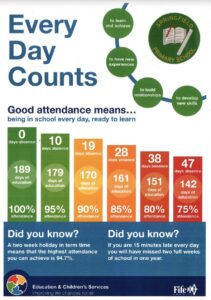
Our aim is that all pupils should attend for at least 95% of the school year. Evidence suggests that children/young people who attend for 95% or more of the school year have the best future attainment outcomes. It is important that good attendance routines are established from the very beginning of a child’s time at school. Excellent attendance supports social and emotional development and positive routines and habits. It helps pupils to develop and sustain friendships. Attendance below 85% falls into the cause for concern bracket. There is evidence that absences pushing attendance below 85% have a significant impact on overall attainment and development of skills for learning, life and work.
Why the drive for improved attendance?
Below are some important figures and the impact this can have:
• Attendance of 95% for the year equals 10 days that the pupil has been absent, that is 2 full weeks of learning missed for that year.
• Attendance of 90% for the year equals 19 days that the pupil has been absent, that is almost 4 weeks of learning missed for that year.
• Attendance of 85% for the year equals 29 days that the pupil has been absent, that is almost 6 weeks of learning missed for that year.
• Attendance of 80% for the year equals 38 days that the pupil has been absent, that is over 7 school weeks missed. This is equivalent to almost an entire school term!
What can families do to support good attendance?
To support good attendance, we need to work in partnership with you. Here are some ways that you can support improved attendance:
• Make sure they attend every day that they are well enough to do so.
• Speak to school as soon as possible if you sense any reluctance in your child to come to school so that we can help.
• Book family holidays and breaks away in school holidays. Almost all holidays taken in term time will be recorded as unauthorised. This includes breaks which extend the school holiday even by a day or two. There are rare circumstances where a short holiday/break can be authorised (e.g., when it is for the wellbeing of the family or because a parent’s employer won’t allow them to take leave in school holidays) but we strongly recommend parents discuss this with the school before booking.
• Try to book all non-emergency appointments out with the school day.
To help accurate recording of school attendance:
• Email/call the school at the earliest opportunity to notify the reason for absence.
• Inform us in advance if your child needs to attend an appointment in school time or if they are going to attend a cultural, religious, sporting or competitive event.
Punctuality:
Punctuality is as important as good attendance to the wellbeing and learning of your child/young person. Arriving on time helps create good habits and allows them to settle into the school day, with their peers. When children/young people are late essential teaching inputs and social interactions are missed.
We understand that sometimes pupils may arrive late for reasons out with their control.
To support good attendance, our schools strive to make sure:
• Every child/young person is happy in their friendships at school.
• Every child/young person is happy in their learning at school.
• Every parent knows who they can come to with concerns at an early stage.
At Springfield PS we have an increased focus on improving school attendance. We will communicate with you regarding attendance rates.
Types of absence
Each absence is classed as authorised or unauthorised. Absences are authorised where reasons are considered valid and unauthorised where no explanation, or unacceptable reasons are given.
Authorised absences
We understand that life can present challenges, and there may be times when absence is unavoidable. Let your school know in the first instance. Your child’s pupil support teacher/guidance teacher is there to offer support if necessary.
The following reasons are considered acceptable:
- medical or dental appointments
- family bereavements
- holidays where parents are in any Uniformed Services
- participation in a show or event
Unauthorised absences
The following reasons are not considered to be acceptable:
- shopping visits
- days out to theme parks or to attend concerts/shows
- family work commitments or business trips
- holidays taken in term time (including long weekends taken on Fridays and/or Mondays)
Illness
If your child is unable to attend school through illness, you should inform your school. Call the office on the first day of absence, before 9am. You should also let them know the expected return date of your child.
If we do not hear from you, we will contact you to ask where your child is. This is part of our safeguarding responsibilities.
Your school will support you if there are concerns over excessive absence patterns through illness.
Is my child well enough for school?
It can be challenging deciding whether or not to keep your child off school when they’re unwell. Public Health Scotland has a helpful guide – Should I keep my child off school or childcare? This may help you decide when your child should attend school or stay at home, based on their symptoms.
Education of children unable to attend school due to ill health
Your child’s learning may be interrupted if they have long-term ill health. This could be for a range of reasons such as:
- accidents or trauma
- chronic, long term, life limiting or terminal conditions
- mental health issues
- conditions that require repeated medical intervention, such as dialysis
In these cases, we would follow the Scottish Government’s guidance on Education of children unable to attend school due to ill health.
Common childhood conditions, where prompt return to school is expected, will not normally be covered by this guidance.
All staff are committed to working with our children, young people and families to support learning and wellbeing through best possible attendance at school. If you have any concerns, do not hesitate to get in touch – we are here to help