The Decider Skills
The Decider Life Skills are proactive mental health skills that are designed to help us all to be more resilient, resourceful, responsible, robust, and respectful. The Decider Life Skills aim to improve emotional intelligence and help our brains develop more positive habits. They provide the skills to help us monitor and manage our mental health.
The Life Skills are 12 Cognitive Behaviour Therapy (CBT) and Dialectical Behaviour Therapy (DBT) skills designed to be taught to groups and individuals using a fun, creative and interactive style.
Information for Parents
Download the Parents & Supporters leaflet.
THE 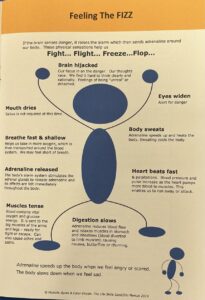 FIZZ
FIZZ
The “FIZZ” refers to the “physical signs of emotion”. We need to understand emotion and what it feels like for us before we can start using the skills.
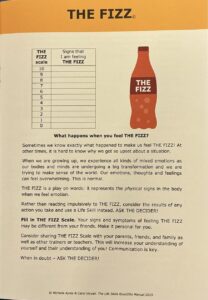 Then we can put our emotions into the “FIZZ” scale.
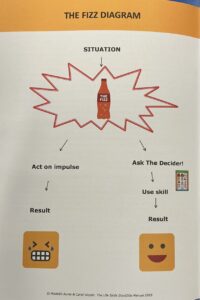 We need to know about our “FIZZ” scale before we can use the decider. This helps us to understand our emotions and that we are able to do things to help recognise and manage these emotions.
This helps us to break the cyclical process of having thoughts and how 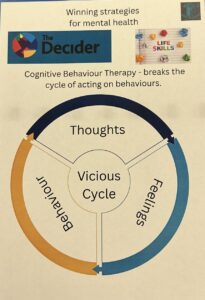 these thoughts make us feel but not to react immediately. It helps us to regulate our behavioural response to those thoughts and feelings in a rational way.
SKILLS
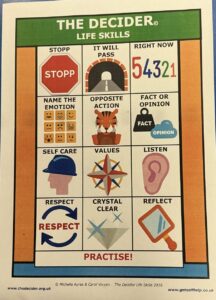 The Decider Skills are Winning Strategies for Mental Health. We need proactive mental health! We can learn skills to recognise and manage our emotions and mental health BEFORE we need them. The Decider Life Skills are evidence based, effective, memorable, fun skills that are easy to learn and easy to teach.
What are those skills?
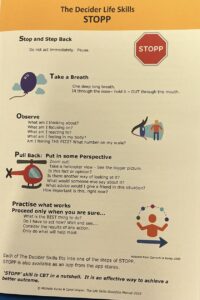 Stop, Take a breath, Observe, Pull back, Practice.
This teaches us to not react immediately and to take time to assess the situation.
It will Pass – the feeling we have will not last forever.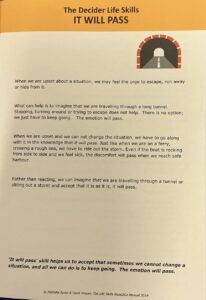
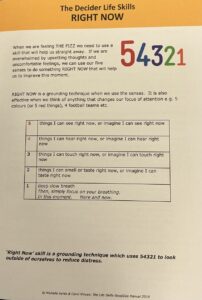 54321 – This helps us to think of positive things to help us regulate our emotions.
Name that emotion. Helps children to recognise the emotion they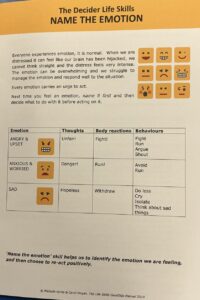 feel.
feel.
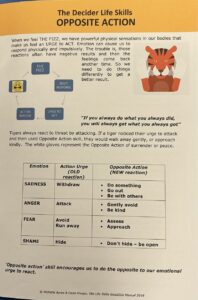 Opposites – This helps us to understand that if we keep reacting the same way the feeling will not change. We have to do something to change it.
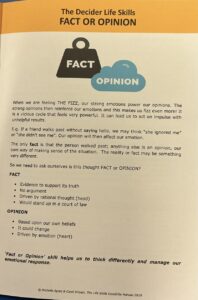 Fact/Opinion – This helps us to look at the issue and work out if it was a fact that something happened to make you feel like this or is it your opinion. E.g. Did your friend not hear you or did they ignore you for no reason.
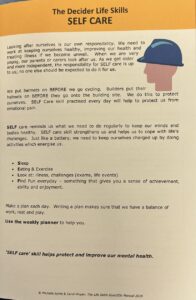 Self care – Is all about looking after yourself so you can deal with the issues you face.
Sleep, Eat, Look at (Illness, challenges), Find fun every day.
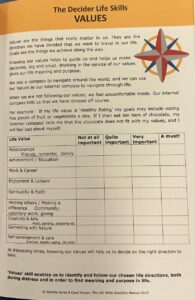 Values – our values are important to us. If we don’t follow our values we don’t feel good.
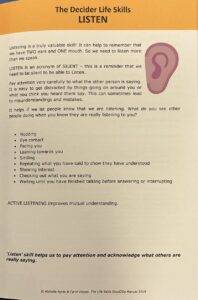 Listen is an acronym for Silent – We have to be silent to be able to listen.
Active listening improves mutual understanding.
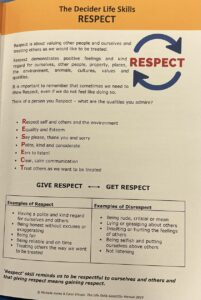 Respect – Give Respect – Get Respect
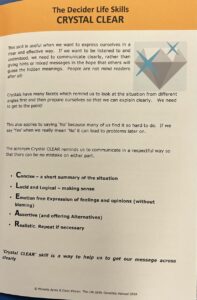 Crystal Clear
Clear communication.
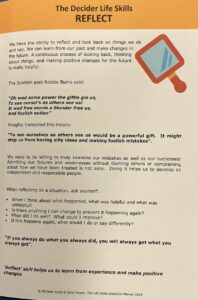 Reflect
We have the ability to reflect on the past and make changes for the future.