Our Casework Management Process
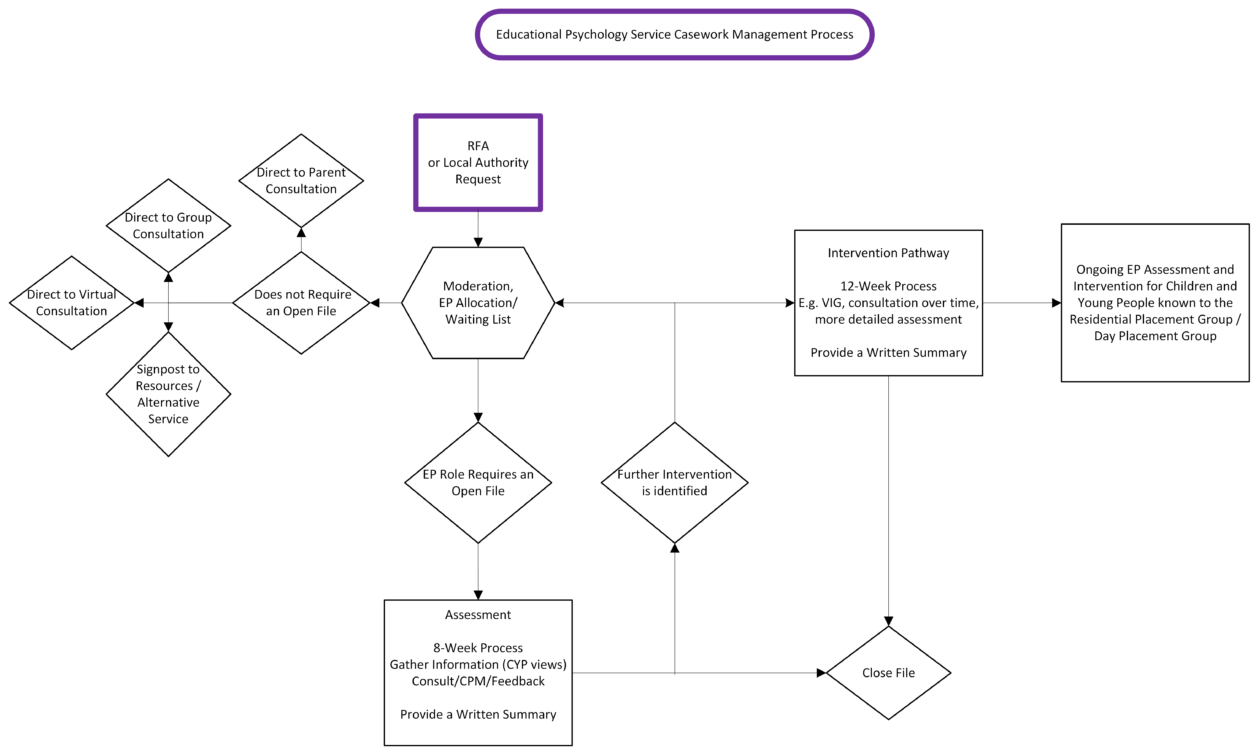
The image above summarises our new Casework Management Process.
Schools will send Requests for Assistance (RFAs) to the Education Hub (EducationRequestforAssistance@dumgal.gov.uk) which is then sent to the EPS' Central Moderation Team. The Moderation Team will discuss whether there is a role for an EP that requires an EPS file to be opened for assessment, or whether alterative supports are more appropriate. The Moderation Team will allocate cases to EPs in the following priority: the school's link EP, a locality EP (East/West), and finally any EP with capacity.
If no EP has capacity, the child or young person will then be placed on the EPS’ Waiting List until such a time that an EP has capacity to become actively involved.
If the outcome of the Moderation Team is that the RFA does not require an open file then schools may be directed to either Virtual Consultation, Group Consultation, Parent Consultation, specific resources, or to a more appropriate agency.If the outcome of the moderation team is that the RFA does require an open file, then an EP will be allocated to carry out an 8-Week Assessment block which could include gathering views from the school/family/child, and assessing needs. The EP will then provide a written summary and either close the file or, if they determine that there is a further role for the EP, go back to the Moderation Team to determine whether an Intervention Block is needed.
If a further role is agreed upon by the moderation team, an EP will be allocated dependent on capacity, to carry out a 12-Week Intervention Block. This could include carrying out Video Interactive Guidance, consultations over time, a specific wellbeing intervention, and others. After this period, the EP will either close the file or refer back to the Moderation Team for further discussion.
The only instances of continuous, ongoing EP involvement is for children and young people who are either on the Day Placement Group, or the Residential Placement Group such as those who are out of authority.