Why?

· It is important to track progress. It may seem a learner has not made much progress, for example if they are still in the silent period, but monitoring of progress will show that they are developing in other areas.
· Monitoring identifies pupils who are not progressing as quickly as anticipated and reveals areas which may require targeted support.
· Monitoring is used to identify targets/next steps for bilingual pupils.
· Schools need to report accurate data on pupil language levels using the language tab on SEEMiS. This data is captured as part of the ScotXed pupil census.
How?
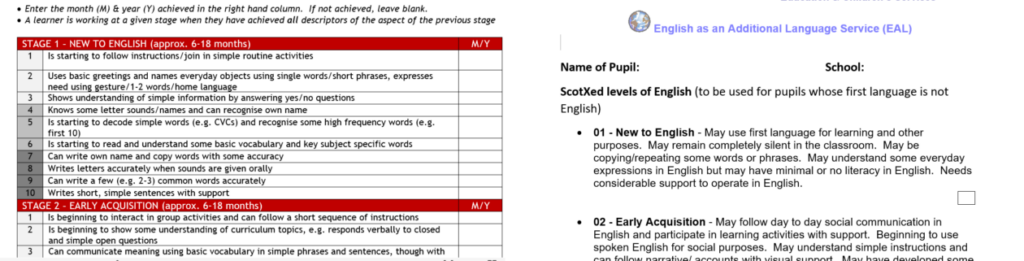
· In Aberdeenshire, the EAL Service support schools with monitoring and tracking.
· A range of resources are available to track progress. These include:
§ ScotXed level descriptors which provide a basic overview of levels and progress.
§ Edinburgh profiles of competence, which provide a more in depth profile of a learner’s progress.
§ Bell foundation resources – which are very detailed.
Timescale for progression and factors affecting language development
“Research shows that progression from Stage 1 (New to English) to Stage 5 (Fluent – in social and academic English) can take from 5 to 10 years. The rate of progression is dependent on a range of factors including pupil motivation, age, level of competence in first (and other) languages, previous educational experience, general cognitive ability, personality and home educational values and support. In addition, progress is dependent on the school ethos, the knowledge and expertise of the staff in relation to the use of effective strategies of support and the maintenance of high expectations of pupil progress. Progress is also influenced by the pupil’s entry point to the Scottish school system.” (Extract from Edinburgh Profile of Competence Information)”
See more information in Multilingualism – Aberdeenshire EAL Service -> Stages of language acquisition