Prior Knowledge

Remember to consider the child’s previous educational experiences. They may come with knowledge of a range of mathematical concepts and vocabulary in their first language.
First Language (L1)
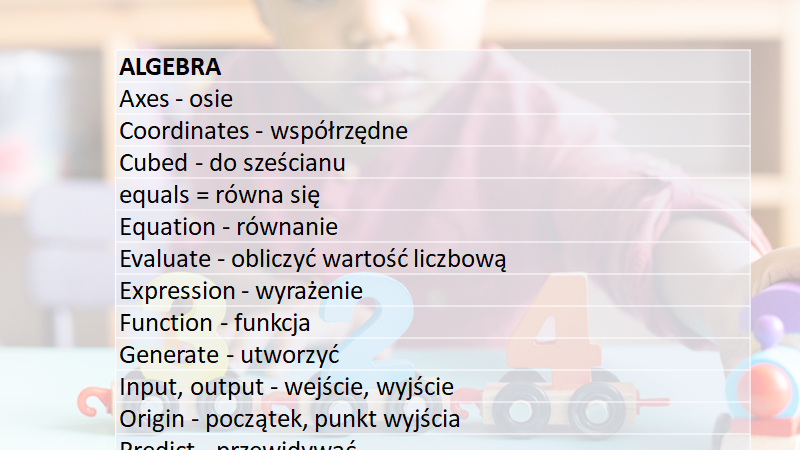
Use translated resources and glossaries if the child is literate in their first language. Many resources can be found in a range of languages online and accessed through the EAL Service. As always, the range of available resources depends on the language required.
Support Language

Include the child in a group and provide context for new vocabulary through demonstration, visuals etc. Use target vocabulary in both spoken and written form alongside practical examples for context.
Cognitive or Linguistic
Cognitive ability not linguistic ability
Do not hold the child back in maths or put in a low set group just because of unfamiliar language – many pupils arrive operating at an advanced level (it is important to refer to translated school reports from the child’s previous school to confirm their skills across the curriculum).
Although children may be new to English, they may understand advanced concepts. An earlier section emphasised the importance of acknowledging prior knowledge and learning. Part of recognising prior experience is understanding that children may lack the English vocabulary to show prior learning. This can be really frustrating for the child.
Pre teaching key vocabulary, using dual language glossaries, visuals etc. will all support the child to show their knowledge and operate at their cognitive level.
Maths in Different Cultures
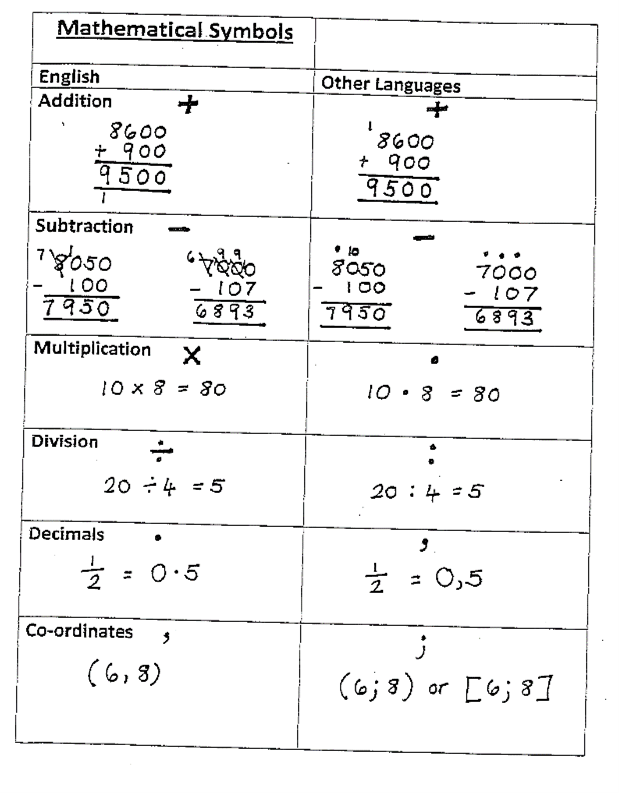
Picture with thanks to S. Webster
Be aware of the many different mathematical symbols and methods of computation used in other languages.
· There may be differences in how some concepts are taught, for example how to carry ten in chimney sums etc.
· In some countries a dot is used in place of x for multiplication and a colon is used as a division symbol. A comma may be used rather than a dot for decimal points and a colon in place of commas for coordinates. This may cause some confusion if the child comes across symbols and misinterprets them. See the shown example above and more information online: Math Symbols: International Notation Guide
· It is also worth bearing in mind that some languages read from right to left, which may be challenging for pupils when they encounter English numbers and have to read them in the opposite direction from what they are used to reading.
· There are also differences in how numbers are written in some languages. Again this can be a challenge, especially where some numeric characters are false friends with those in other languages which have different values e.g. ٥ is Eastern Arabic for ‘5’ and ٦ for ‘6’. Here is a table comparing some of the different number systems (Wikipedia):
|
Examples of different number systems (Source Wikipedia) Symbol |
Used with scripts |
Numerals |
|||||||||
|
0 |
1 |
2 |
3 |
4 |
5 |
6 |
7 |
8 |
9 |
many |
Arabic numerals |
|
𑁦 |
𑁧 |
𑁨 |
𑁩 |
𑁪 |
𑁫 |
𑁬 |
𑁭 |
𑁮 |
𑁯 |
||
|
० |
१ |
२ |
३ |
४ |
५ |
६ |
७ |
८ |
९ |
||
|
০ |
১ |
২ |
৩ |
৪ |
৫ |
৬ |
৭ |
৮ |
৯ |
||
|
੦ |
੧ |
੨ |
੩ |
੪ |
੫ |
੬ |
੭ |
੮ |
੯ |
||
|
૦ |
૧ |
૨ |
૩ |
૪ |
૫ |
૬ |
૭ |
૮ |
૯ |
||
|
୦ |
୧ |
୨ |
୩ |
୪ |
୫ |
୬ |
୭ |
୮ |
୯ |
||
|
᱐ |
᱑ |
᱒ |
᱓ |
᱔ |
᱕ |
᱖ |
᱗ |
᱘ |
᱙ |
||
|
௦ |
௧ |
௨ |
௩ |
௪ |
௫ |
௬ |
௭ |
௮ |
௯ |
||
|
౦ |
౧ |
౨ |
౩ |
౪ |
౫ |
౬ |
౭ |
౮ |
౯ |
||
|
೦ |
೧ |
೨ |
೩ |
೪ |
೫ |
೬ |
೭ |
೮ |
೯ |
||
|
൦ |
൧ |
൨ |
൩ |
൪ |
൫ |
൬ |
൭ |
൮ |
൯ |
||
|
෦ |
෧ |
෨ |
෩ |
෪ |
෫ |
෬ |
෭ |
෮ |
෯ |
||
|
၀ |
၁ |
၂ |
၃ |
၄ |
၅ |
၆ |
၇ |
၈ |
၉ |
||
|
༠ |
༡ |
༢ |
༣ |
༤ |
༥ |
༦ |
༧ |
༨ |
༩ |
||
|
᠐ |
᠑ |
᠒ |
᠓ |
᠔ |
᠕ |
᠖ |
᠗ |
᠘ |
᠙ |
||
|
០ |
១ |
២ |
៣ |
៤ |
៥ |
៦ |
៧ |
៨ |
៩ |
||
|
๐ |
๑ |
๒ |
๓ |
๔ |
๕ |
๖ |
๗ |
๘ |
๙ |
||
|
໐ |
໑ |
໒ |
໓ |
໔ |
໕ |
໖ |
໗ |
໘ |
໙ |
||
|
꧐ |
꧑ |
꧒ |
꧓ |
꧔ |
꧕ |
꧖ |
꧗ |
꧘ |
꧙ |
||
|
٠ |
١ |
٢ |
٣ |
٤ |
٥ |
٦ |
٧ |
٨ |
٩ |
||
|
۰ |
۱ |
۲ |
۳ |
۴ |
۵ |
۶ |
۷ |
۸ |
۹ |
||
|
۰ |
۱ |
۲ |
۳ |
۴ |
۵ |
۶ |
۷ |
۸ |
۹ |
||
|
- |
፩ |
፪ |
፫ |
፬ |
፭ |
፮ |
፯ |
፰ |
፱ |
||
|
〇 |
一 |
二 |
三 |
四 |
五 |
六 |
七 |
八 |
九 |
||