Activate Prior Learning
Activate prior learning
Every child will come with prior learning, even if they have not been in an educational setting before. It is really important to know what the child already knows in their first language as any existing knowledge, concepts and vocabulary will be much easier to learn in English if they already know them in their first language.
· A child who knows the word ‘blue’ in Polish will not need to learn the concept of colours again, only the English word for ‘niebieski’.
· A child who can read and write at length in their first language does not automatically need to go back to learn all of the concepts of decoding, blending, characterisation, adjectives etc again. However, they may need to learn things such as character formation, English letter sounds etc if they are literate in a language other than English.
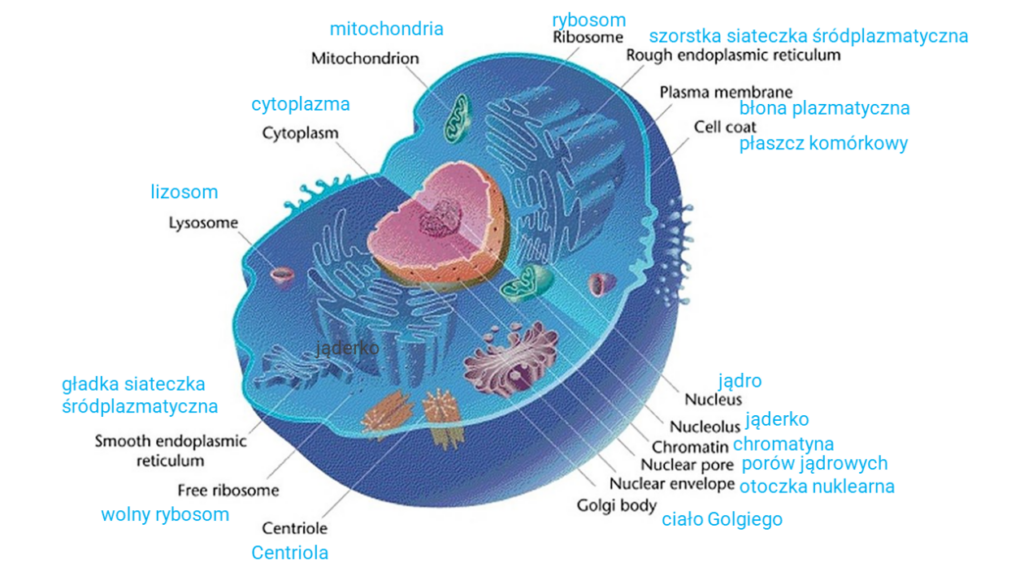
· A child who has already studied chemistry may already know that a covalent bond is a chemical bond that involves the sharing of electrons to form electron pairs between atoms. However they may not have the English vocabulary to express that, even if they are able to say hello and ask what’s for lunch. Dual language glossaries, key word lists, annotated diagrams and dual language dictionaries will be helpful for pupils in these circumstances.
Teacher Talk

Teacher Talk
· Limit amount of teaching talk to focus on key messages.
· Give one instruction at a time and repeat it to give the pupil a chance to absorb and process the information.
· Rephrase information/instructions. A good way to do this is to ask another pupil to tell the class what has been said/what to do, as they will often find a different way to explain that may be helpful to the pupil.
Good Models

Good models
Provide lots of good models of English, written and spoken (through books, resources, peers, ICT).
Think carefully about where the child will sit. Pair the pupil with a responsive, caring pupil who can act as a role model and guide. It’s also important to make sure they can see the screen/board and anything else which will give context to language. It’s also important that they can hear clearly.
Context
Context
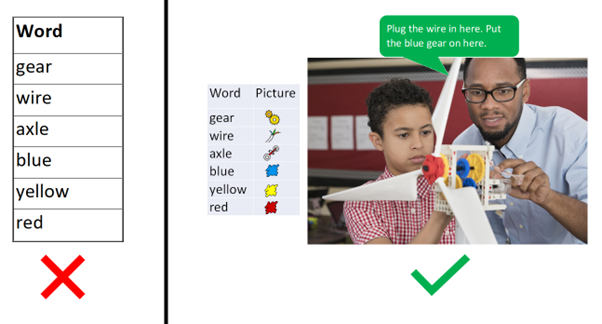
Use language in context rather than teaching words and structures without context. Whether spoken or written, it is easier to learn new words if you are using them in a meaningful way.
Differentiation
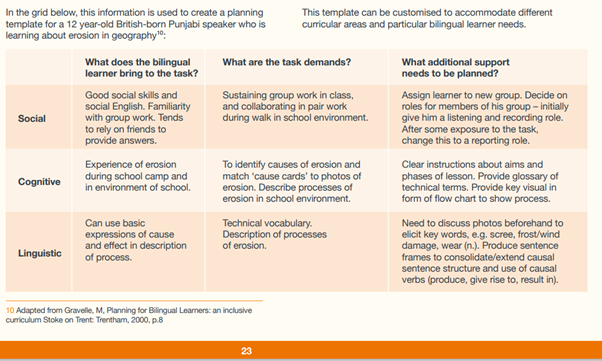
Remember to differentiate on a linguistic and not cognitive basis. Learning should be at children’s academic level rather than their level of English.
· Use visuals
· Pre-teach key vocabulary
· Encourage learners to take an active role in activities
· Pupils can sequence images to show understanding.
The above table from Learning in 2+ languages shows how you can consider the social, cognitive and linguistic demands of lessons and how to support children in accessing learning at their cognitive level. (You can zoom in if the text is too small to read).
Maximise your pupil's learning experience

Whatever the learning focus take the opportunity to provide more input to support pupils’ language acquisition.
· Reinforce key vocabulary and provide good models of English in context (as discussed in a previous section).
· Even when activities seem mundane and routine there is an opportunity to provide models of English. For example, when asking someone to hand out resources you can hold up each resource as you name it.
· While waiting anywhere you can talk about the area around you and introduce relevant vocabulary.
· When you are asked to help with spelling there might be an opportunity to explain a general rule.
Mainstream

Mainstream
Involve children in mainstream activities from the start. Children will learn best when they are immersed in the English language environment and hear good models of English being used in the context of their daily learning and activities.
To encourage language acquisition, in-class support which allows bilingual pupils to work alongside their peers, is preferable to being withdrawn to work one to one with an adult.
Assessment Arrangements

Assessment Arrangements
Be aware of SQA Guidelines on assessment arrangements which include guidance on use of a bilingual dictionary for candidates who speak English as an Additional Language. See the strategies section for further advice on use of dual language dictionaries.
Homework

It is hard work thinking/translating/speaking in a new language all day, every day.
· Do not worry about homework initially – pupils need rest time.
· Parents may not be literate in English and therefore not able to help.
· Pupils and parents may not understand homework expectations, which may be very different from their experience of homework in a different education system. Communication with parents is important, make use of an interpreter if required.
· Parents may be at work and not available to help.
· Check that the family have access to technology and an internet connection. Also confirm if they know how to use translation tools.
· Gradually introduce simple tasks – The pupil may have to complete them in school until language has developed sufficiently and a routine is established.